Thursday, March 17, 2022

"Papcio Chmiel" Film Screening with his Daughter, Monika Chmielewski Lehman, 27 February 2022


Henryk Jerzy Chmielewski, Wikimedia Commons

 Helena Modjeska Art and Culture Club presented the screening of the documentary film entitled "Papcio Chmiel",  directed by Petro Aleksowski, at the home of Monika and David Lehman, in Pasadena, CA. The meeting was  held at 5:30 pm on Saturday, 27 February 2022.


Henryk Jerzy Chmielewski, Wikimedia Commons

"Papcio Chmiel" is a documentary about the Polish artist Henryk Chmielewski - the author of the famous comic book "Tytus, Romek and A'Tomek". When appearing in  the film "Papcio Chmiel" he was 97 years old and his art is seen through the prism of the perception and passion of a 12-year-old boy, and as seen by scholars, students, family and friends.  These multiple perspectives enriched the film. 

The artist, born in 1923, died in 2021, after a turbulent life, incl. participation in the Warsaw Uprising in 1944, in the 7th Infantry Regiment of the Home Army "Garłuch". In 1950–1956 he studied at the Academy of Fine Arts in Warsaw at the Faculty of Graphics. He worked as an illustrator in the popular press, and from 1957 he published a series of comics about two boys and their long-tailed friend. He published 31 volumes of this comic book by 2009, and then created a series of unnumbered books about his young heroes taking part in historical events - the Warsaw Uprising, the Battle of Warsaw in 1920, the Battle of Grunwald, the Vienna Relief of King Jan Sobieski, etc

Ulica Papcio Chmiela, Wikimedia Commons

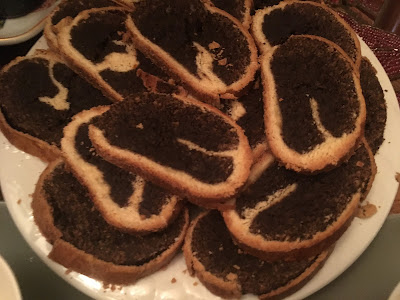
After the buffet dinner at 6pm and the film screening of the film at 7 pm (buffet dinner prior to screening), there will be an interview with the daughter of the artist, Monika Chmielewska Lehman. The  buffet dinner will include two special organic and health dishes created by Eliza Boughous, Ms. Lehman's friend and personal chef - Nutty Red Rice with Herbs and Mushroom Medley. In addition we will serve Armenian Chicken and Japanese Sushi rolls. For dessert homemade cakes: "Bergerowka" by Marek Berger with red oranges, sponge cake with nectarines by Ewa Malachowska and two-color cake by Mary Kubal,


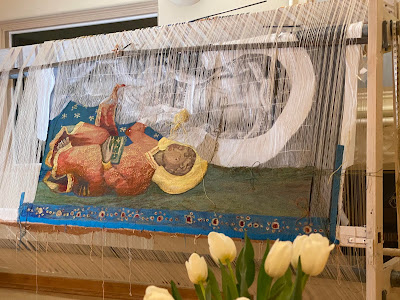
MONIKA CHMIELEWSKA LEHMAN - who organized the event in her home created a tapestry with the likeliness of her father (above) and was working on a tapestry of Our Lady of the Bright Mount for the Catholic Cathedral in California (former site of the Crystal Cathedral). For her generosity she received white tulips and a diploma from the Club. 

https://modjeskaclub.blogspot.com/2018/12/january-12-2019-monique-lehman-and.html

Monika Lehman z najnowszym gobelinem w trakcie pracy

Monika Chmielewski Lehman, Artur Chmielewski z dyplomem od Klubu.


Maja Trochimczyk, Beata Czajkowska, Basia Nowicka, Elzbieta Kanski


Friday, December 31, 2021

Forgotten Ancient and Medieval History of Poland by Janusz Bieszk on Zoom, January 15, 2022 at 12 pm PST

Tadeusz Wolanski's discovery of ancient Polish medals, 1842
YouTube Video from the Lecture: https://youtu.be/5oXLLizDAtQ

Helena Modjeska Art and Culture Club is pleased to invite you to a lecture on Saturday, January 15, 2022 at 12 noon in California. Please send requests for a Zoom link and detailed information to prezes@modjeska.org.

Janusz Bieszk: The Kingdom of Lehia and the Kingdom of the Weneds in the ancient and medieval periods

Lecture by zoom January 15, 2022, noon in California, Gdynia - Los Angeles. The entire presentation will be in Polish.


I. Author's biography:

Janusz Bieszk, born in 1948 is a history enthusiast and researcher, and  a bibliophile. He holds a master’s degree in the field of foreign trade and foreign service. For many years, he worked in managerial positions in Poland and abroad. With a passion for forgotten history he pursued his interests for decates and included the results of his independent historical research in a series of popular books describing the following historical periods:


1. Prehistory - Space Civilizations on Earth,

2. Antiquities - Slavic Kings of Lehia in Ancient Poland,

    The Kings of Lehia and Lehites in History,

    Ancient Kingdom of Lehia

    More Evidence, Forgotten Ancient Kingdom of Lehia II

    Evidence and Historical Atlas of Lehia, Sarmatia, Scythia,

3. The Middle Ages - Castles of the Teutonic State in Poland and

    Christian Kings of Lehia in Medieval Poland.

Mr. Bieszk also edited the introduction and footnotes to the new edition of Prokosz's Slavic-Sarmatian Chronicle from the 10th century, Polish edition.

He documented his books with citations from an extensive Polish and foreign bibliography.

To order books: https://www.swiatksiazki.pl/catalogsearch/result/?q=Bieszk+Janusz


Mr. Bieszk cordially invites you to experience together and discuss the documented stories about our great and outstanding ancestors of the Aria-Praslavians, the kings of Lehia, the knights of the coat of arms Leh and the steadfast sailors of Weneds.

II. Title:

The Kingdom of Lehia and the Kingdom of the Weneds in the ancient and medieval periods.

As the introduction to the lecture, Maja Trochimczyk will show a photo with all published books by the author, and a 3-min YouTube video under the title "The Lehia Empire and its Capitals  through the ages. Mr. Bieszk will provide comments to this introduction.

III. Sections of the lecture:

1. Definitions: "Slavs" in Polish are Slawianie, not Slowianie. Lehia, Leh, Lehici with "h" not Lechia, Lech, Lechici with “ch”

2. The meaning of the words "Leh" and "Lehía", and also Leh = Wit or Wist.

3. Slavs or Slawianie as an agricultural, peaceful, free and religious people

4. Religion and beliefs of the Pra-slavians

5. The oldest historical sources (yearbooks, chronicles)  with information

    - domestic

    - foreign

6. The oldest artifacts and facts

    - construction of the Praslavians

    - Praslavian battles

    - the oldest image of a freight car

    - inscription on the tombstone from the 1st century AD

7. A short and full set of Sarmatian-Lehitic kings

8. The kings of the Weneds

9. Emperors of Lehia Empire

10. Historical Atlas of Lehia, Sarmatia and Scythia

11. Catalog of coins minted by the rulers of Lehia

The presentation will conclude with presenting Mr. Bieszk’s three Open Appeals to the national authorities followed by participants' questions and discussion.

19th Century edition of the Prokosz Chronicle with inserted portrait

LEHIA ON THE MAP

https://www.youtube.com/watch?v=gaN1B7vkFOk&t=6s 

Ancient medal discovered by Wolanski, 1842

Janusz Bieszk’s interview for Nowy Dziennik Polish Weekly (September 14, 2016). Th. 4.

- Do you think that knowledge about the ancient history of Poland is hidden? What is the reason for this?

Everything points to the fact that we still have a post-church history and a pro-church history, where many topics, events, facts and even historical figures like kings are taboo.

For example knowledge of the following facts has not been described in the historical literature and information about these facts has not been disseminated in the society:

1. The above-mentioned tombstone with a dedication from Emperor Tiberius Claudius, translated from Latin and published in 1843 by Polish researcher, archaeologist and numismatist Tadeusz Wolański, who studied our ancient history.  Wolanski considered Prokosz Chronicles of the 10th century to be true history of ancient Poland.  In 1853 the Roman-Catholic Church declared his books forbidden and burned them at the stake. His conviction was prevented by the intervention of Tsar Nicholas I, who also assigned a detachment of the Russian Army to protect him during his research travels and expeditions.

It is long overdue that a faithful copy of the ancient Roman tombstone of a Lehia prince should be exhibited for the public at the Royal Castle or the National Museum, as the oldest artifact concerning Kings of Lehia dating back to the 1st century

2. Lehia and Sarmatian warriors were engaged in many battles with the Roman legions, and plentiful evidence exists in historical sources;  however, it is not disseminated.

3. The reign of the Lehite king Wrocisław in the years 892-896 is not known or publicized while it pre-dates the Piast dynasty by 70 years. The evidence in the chronicle of Prokosz and the Aventinus annals is ignored.

4. The existence of the empire of Lehia in the years 1000-1038 is also ignored, despite the evidence contained in Polish and foreign chronicles and annals.

5. The reign of Bolesław II the Forgotten in the years 1034-1038 is not known to today’s historians and readers.  He was removed from the Roman Catholic Church and thus doomed to oblivion.  His “deletion” from Polish history remains to this day, so the Church’s anathema has been quite effective. His name is not mentioned in two historical albums published in Poland in 2014 and 2015 with lists of kings.

Ancient medal with the king Mieczyslaw, and religious symbols, Christian and pagan
Tadeusz Wolanski's discovery, from 1842 book

Q: When do you think Poland was baptized?

A: According to Polish and foreign historical sources, the baptism of the people of Lehia was not a single act that took place in 966 AD, but a multi-stage act, involving both  the Roman-Catholic and Eastern Orthodox, Slavic (Cyril-Methodian) rites. Its chronology was as follows:

1. During the reign of King Koszyszko (842-862) on January 1, 845, fourteen Lehs - Lehite princes and magnates, with their courts, army and people living in the south, on the border with Moravia and Bohemia were solemnly baptized in the Roman Catholic rite. Baptism was performed by priests with Archbishop Adalram from Olomouc in Great Moravia, who was subordinate to the Archbishopric in Passau, Bavaria. The above act had a practical and tactical goal, namely to avoid the future military invasions of Christianization by the aggressive East Frankish state.

2. In the middle of the 9th century, especially during the reign of King Ziemowit the Reformer (862-892) and with his consent, the Christian religion in the Eastern Orthodox, Slavic rite began to penetrate the population of Lesser Poland. It was taught by the priests of Wisnog and Oslaw, students of Archbishop Methodius, who was in Velehrad in Great Moravia. The bishop of Lehites at that time was Sawa, a student of Cyril. Religion in the Slavic rite later spread to Lesser Poland, Silesia and Greater Poland, covering a large area of ​​Lehia. Many Orthodox churches were built in such localities as Wiślica, Kraków, Przemyśl, Wrocław, Poznań, Ostrów Lednicki (Lechicki) and Gniezno.

This was confirmed by archaeological excavations. The archbishopric of the Slavic rite in Krakow functioned for over 150 years.

3. Some kings of Lehia and their courts and attendants were baptized in the Eastern Orthodox, Slavic rite and ruled together for over 100 years as Christians. In my opinion, they were:

Ziemowit Reformator, who ruled in the years 862-892;

Wrocisław who ruled in 892-896;

Leh X Brave in 896-921;

Ziemomysl in 921-957;

Mieczysław II in 957-999.

The first king called Mieczysław ruled in 340-388. According to Polish chronicles and annals, Mieczysław II died in 999. Mieczysław II was elected as king of Lehia at a valid rally in 957, retained the title of king in accordance with the custom (now the so-called protocol) until his death in 999, regardless of the later repercussions related to the transition with his surroundings from the Slavic rite to the Roman rite.

It probably happened in or after 968, because in the so-called in the epitaph of Brave it is written that Bolesław was born in 967, of a "pagan father". This is because the Roman clergy did not recognize the Slavic rite and treated it as paganism. Mieczysław II was baptized by the aggressive German Church, not the Czech one, as there was no archbishopric in Prague at that time.

The official date of baptism of a part of the population of Polania (Poland) should also be backdated to the year 845, but then the public would have to be informed that the use of the later date was purposeful and was designed to hide the existence Lehs - because that is what they are called in foreign sources.

Ancient Polish medal from the book about Tadeusz Wolanski's discoveries, 1842

Ancient map - in arabic marking the Kingdom of Lechia

Lechistan on old Greek map of Europe

Suevi, Wenedae, Sarmatia on map of Roman Empire

Polish Kings from an Austrian print 1655, many Lechia kings.

Inscription of Zygmunt III Waza column in Warsaw, by his son Wladyslaw IV, naming Zygmunt III as the 44th king of Poland; chronology goes back to 5th century and includes many Lechia kings.

Traditional circular layout of a Lechia Slavic village with central grounds for meetings.

Remnants of 55 portraits, 36 extant, of Lech and Polish kings.

Portrait of earliest Polish kings in Kralow, with Krak. Popiel, and Wanda


Tuesday, December 21, 2021

Merry Christmas, Happy Holidays and Best Wishes for 2022!

Dear Friends,

Let me start my holiday wishes for the members and friends of Helena Modjeska Art and Culture Club with a quote from the great 13th century Persian poet, Rumi: “Wear gratitude like a cloak and it will feed every corner of your life.” Gratitude is the most uplifting of emotions; counting the blessings is the key to happiness.

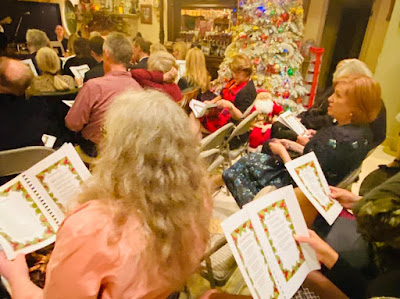
  Among many moments to be grateful for this year in the Club, we had a beautiful caroling party with about 70 guests sharing “oplatek” wafer, special home-cooked dishes, and singing Christmas carols together in the beautifully decorated and welcoming home of Jola and Alex Wilk in Anaheim Hills (December 12, 2021). Henryk Chrostek and Olivia Kierdal led the carol sing-along. 
 
Christmas Carols: https://youtu.be/otMQr9_ZACc

For those who could not get there, on Saturday, December 18, 2021 we organized an international meeting by Zoom: Joanna Sokolowska-Gwizdka from Austin, Texas, gave a richly illustrated lecture about the holidays with Helena Modrzejewska, our club’s patron. There were guests from Texas, Florida and Canada (Agata Pilitowska, winner of our Helena Modjeska Prize 2019) and from Poland (Janusz Bieszk, whose lecture on Lechistan and Lechitach will be held by Zoom on January 15, 2022 at 12 noon).

For those who missed the lecture, here’s the link: 

https://youtu.be/oN_McHjU77k


Holidays are a great time to “feed on gratitude”— that is to cook and share “once-a-year” dishes, based on Grandma’s recipes, passed on through generations. Some of this traditional food is pretty weird to outsiders from other cultural traditions. I find that even my Polish  American friends in California do not have the same menu of Christmas dishes that I carried with me here, as sacrosanct rules for life, recipes for dishes I must cook once per year, or else there is no Christmas… “Kompot” anyone? “Kutia”? “Kapusta z grzybami”? “Karp w galarecie”? Everyone has their least favorite Polish traditional dish…


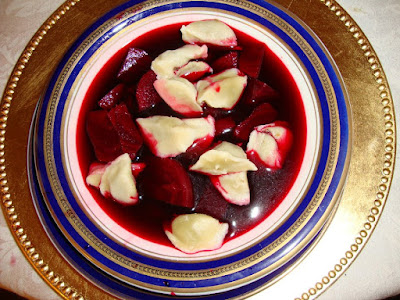
Barszcz z uszkami

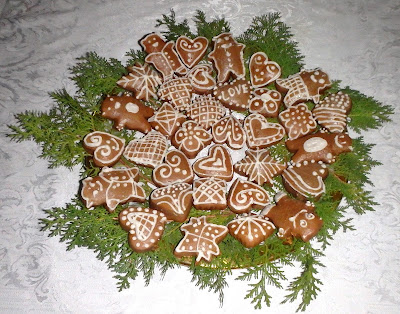
Gingerbread by Marysia Kubal

My friends came from different parts of Poland and do not share those traditions that I am so attached to, though we share our history, language, culture… Yet, we all cherish what's most important about celebrating holidays together: family love expressed without words, by cooking together, laughing together around the kitchen table.  These gifts of companionship and contentment are priceless; they are far more important than anything that money can buy. I tried to capture those feelings in many poems over the years. Today, I’d like to share a holiday poem with all Phoenix House staff and friends as my wishes for Happy Holy Days of many shared delights and blessings!

>Merry Christmas, Happy Holidays, and Best Wishes for the New Year 2022! 

~ Maja Trochimczyk, President


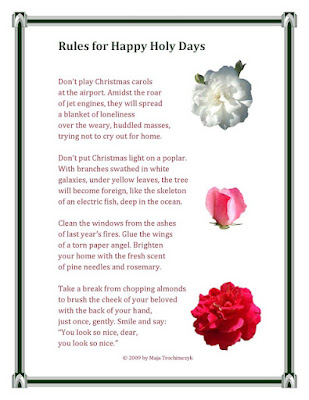
Rules for Happy Holy Days


Don’t play Christmas carols

at the airport. Amidst the roar
of jet engines, they will spread
a blanket of loneliness
over the weary, huddled masses,
trying not to cry out for home.

Don’t put Christmas light on a poplar.
With branches swathed in white
galaxies, under yellow leaves, the tree
will become foreign, like the skeleton
of an electric fish, deep in the ocean.

Clean the windows from the ashes
of last year’s fires. Glue the wings
of a torn paper angel. Brighten
your home with the fresh scent
of pine needles and rosemary.

Take a break from chopping almonds
to brush the cheek of your beloved
with the back of your hand,
just once, gently. Smile and say:
“You look so nice, dear, you look so nice.”

(c) 2009 by Maja Trochimczyk


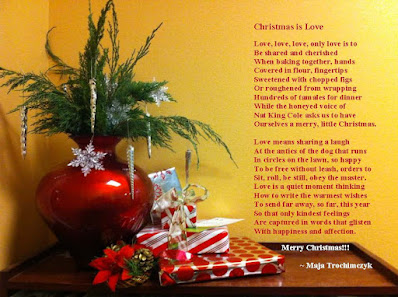
Good News


Did you know that Christmas

is Love, Love, Love, only Love

to be given, shared, cherished?

When baking together, hands

covered in flour, your fingertips

sweetened with chopped figs,

or roughened from wrapping

so many tamales for the family

dinner, while the honeyed voice

of Nat King Cole asks you to have

yourself a merry, little Christmas—


Love means sharing a laugh

at the antics of the dog that runs

in circles on the lawn, so happy

to be free—without leash, without

orders to sit, roll, obey the master.

Love is a quiet moment of writing

the sweetest of wishes to be mailed

far, far away—this year even further.

Love is this letter, filled with affection,

your kind, gentle words that glisten

with happiness & warmth.

(C) 2018 by Maja Trochimczyk

.


Sunday, November 21, 2021

Christmas with Helena Modjeska - Lecture by Joanna Sokolowska-Gwizdka on Zoom, Saturday, December 18, 2021 at 12 noon


The Helena Modjeska Club invites you to a meeting in the Zoom format with Joanna Sokołowska-Gwizdka, a writer and journalist to be held on Saturday, December 18, 2021 at 12 noon. The presentation will be richly illustrated with materials from the author's private archive. The conversation will be led by President Maja Trochimczyk, in Polish. Information by email, please contact prezes@modjeska.org.

Joanna Sokolowska-Gwizdka is the author of the bilingual book "What I received from God and people. A Tale of Helena Modrzejewska". The book, with an introduction by Prof. Kazimierz Braun, was published on the occasion of the 100th anniversary of the actress's death. Since then, Joanna Sokołowska-Gwizdka, who for many years has been getting to know this famous Shakespearean actress, brings the actress's biography to the public during many meetings in various cities of the USA, Canada and Polish. We recommend buying a book as a gift for Christmas:

https://www.amazon.com/gp/product/0615293441/ref=dbs_a_def_rwt_bibl_vppi_i0

What I Received from God and from People. A Story of Helena Modjeska (Modrzejewska). 


She is also a co-author of the play about Chopin "Good Evening Monsieur Chopin", translated into English, French and Portuguese, staged in Canada, the USA, Brazil, France and Portugal by the Salon of Poetry, Music and Theatre from Toronto. She wrote a monograph of the Polish theatre in Toronto "Theatre of fulfilled hopes. Cards from the life of the emigration scene". Against the background of the history of theatre, the author showed people with passion, who were united by theatre Polish in exile. She conducted 270 hours of interviews with Polish artists in Toronto, associated with the theater. Many of them are no longer alive, making the publication a unique document. The premiere of the book took place at the XX International Book Fair in Krakow, and the promotion took place at the Słowacki Theatre, from which the founder of the theatre – Maria Nowotarska – originated.. In 2018, she received for this book the Polish "Booker Prize" in the Literature category – that is, the Golden Owle statuette awarded in Vienna by the Club of Polish Intelligentsia in Austria, presented during a ceremony at the Vienna station of the Polish Academy of Sciences.


Since 2016 edits an online cultural magazine devoted to Polish culture outside Poland, "Culture Avenue": www.cultureave.com. For editing this magazine, in 2018 she received the Maciej Płażyński Award granted by Club Press Polska and presented at the Emigration Museum in Gdynia. Since 2001, he has lived abroad, first in Toronto, then in New Jersey, near New York, and since 2013 in Austin, Texas. She is a graduate of Polish philology at the University of Lodz. After graduation, she worked at the Department of Old Polish Literature of the University of Warsaw, under the direction of an outstanding historian of Polish literature, Prof. Jerzy Starnawski. 

At the same time, she was engaged in journalism. She participated many times in the Music Festival in Łańcut as a correspondent of the Łódź "Odgłosy". In the mid-90s, she became a media representative and organizer of the promotion in Poland of the International Chopin Festival, held in La Châtre-Nohant in France. She also cooperated with Telewizja Łódź (program "Rozmaitości Literackie") and with "Głos Polonii" - Polish radio in Perth (Western Australia). After going abroad, she worked in "Gazeta" in Toronto - the largest Polish diaspora daily in Canada. From January 2003 to June 2008 she was the editor-in-chief of "Oceanic Letter" - a cultural supplement of "Gazeta". While living in Toronto, she also conducted interviews with representatives of the world of culture on the television station "Polish Studio". After moving to New Jersey in 2005, she worked at the Pilsudski Institute in New York on the digitization of the Institute's archival collections.


Her articles, reviews and interviews were published in magazines in Poland: "Rzeczpospolita", "Pani", "Dziennik Łódzki", "Odgłosy", "Jazz Forum" and abroad: "Nowy Dziennik" (New York, New York), "Polonia Kalifornijska" (San Diego, California), "Teraz" (Philadelphia, Pennsylvania), "Polonaise" (Cairo, Egypt), "Kurier Zachodni" (Perth, Western Australia), "Tygodnik Polish" (Sydney, Australia), "Pro Polonicum" (Freiburg, Switzerland). Chapters in books have also been published ("Horyzonty Teatru II. Droga Kazimierza Brauna", Toruń 2006, "Words, images and sounds in upbringing", Warsaw 2011, "Axiology of travel", Warsaw 2012). As a member of the Association of Polish Writers Abroad based in London, she is also associated with the "Literary Diary" – a magazine published by the union.

Currently, he is the vice president of the Austin Polish Society and one of the directors of the Austin Polish Film Festival. As part of the cultural activities of the organization, it also runs the Historical Club. Before the pandemic, the story of the Potocki family from Łańcut began a series of lectures entitled Polish Families. During the pandemic, she organized meetings via the zoom platform, m.in with Kazimierz Braun, Jarosław Abramow-Newerly, Marek Probosz, Iwona Korga – director of the Pilsudski Institute in New York and Tomasz Jędrzejewicz – son of a pre-war minister and co-founder of the Institute. 

She set up a YouTube channel to bring Texas and Polish traces in Texas closer to those who couldn't travel during the pandemic. In May 2021, she co-organized the Poli Negri Festival in Austin.


LINKS TO PURCHASE THE BOOK

https://www.amazon.com/gp/product/0615293441/ref=dbs_a_def_rwt_bibl_vppi_i0

What I Received from God and from People. A Story of Helena Modjeska (Modrzejewska). Paperback – January 1, 2009


LINKS TO INTERVIEWS 

Interview with Mariusz Kotowski, author of a documentary about Poli Negri. 

https://www.youtube.com/watch?v=C-jkzRwKLqc

Interview in radio PiK (Pomorza i Kujaw) before a lecture on Helena Modjeska in Bydgoszcz, 2019 

http://www.radiopik.pl/121,242,6-sierpnia-2019?fbclid=IwAR3HlB7uzYGZuG2eE3qZY7FxviSh94P3Q1Zdiql94JJ1Q_p8E-BULTZ9reA

Newest intervieww on portal Kultura Na Co Dzień:

https://kulturanacodzien.pl/2021/09/08/joanna-sokolowska-gwizdka-pisarka-dziennikarka-dzialalnosc-artystyczna-z-pandemia-tle/


Wednesday, November 17, 2021

Modjeska Club's Christmas Carols Party on Sunday December 12, 2021 in Anaheim Hills, CA


Christmas is coming and it is time to return to the warm comfort of Christmas Carols, Christmas trees, Christmas  gifts, Christmas lights and… the Christmas Caroling Party of the Modjeska Club held on Sunday, December 12, 2021 at 4:30 pm at the elegant and beautifully decorated residence  in Anaheim Hills, CA. After sharing “oplatek” and holiday dinner, Christmas Carols will be performed by Olivia Kierdal with Henryk Chrostek who will then lead the guests in singing along our favorite Polish Christmas carols. Songbooks will be provided. 


Olivia Kierdal was born and raised in Sydney, Australia, and moved to Los Angeles in 2019. She completed a BA in Contemporary Music and is a classically trained pianist, a vocalist and songwriter with over 100,000 monthly listeners on Spotify.


Henryk Chrostek was born in Poland and moved to the U.S. in the late 80s. In his professional life he works for University of Southern California as a Director of Research Administration, Ostrow School of Dentistry. In his private life he is a hobbyist musician playing guitar, writing, recording, and performing live locally but also all over the country. In 2014 with Ewa Angeli he recorded for the first time in history an album with Polish Christmas Carols in English which is available on Amazon, iTunes, CDBaby.com and other music retailers worldwide.


Our Christmas Party will include potluck dinner of home-made dishes and desserts made by Club members. We propose the following dishes: kapusta z grzybami, bigos, herring, salmon, gołąbki, ryba po grecku, baked ham, kulebiak, salads, bread/pumpernickel, as well as desserts makowiec, pierniczki, szarlotka, sernik, keks, piernik, i kruche ciasteczka. 

Merry Christmas & Happy New Year!

 Dr. Maja Trochimczyk, President